


The more than sign ( > ) is one of the most widely used mathematical symbols in the world more than sign. From elementary school arithmetic to advanced programming languages and scientific formulas, this simple symbol plays an important role in comparing values. Although it looks small and simple, the more than sign helps people understand relationships between numbers, quantities, and even logical expressions.
Many students first encounter this symbol during their early math lessons when they begin learning how to compare numbers. However, its use extends far beyond the classroom. It appears in computer programming, statistics, spreadsheets, economics, and everyday calculations.
In this detailed guide, you will learn everything about the its meaning, history, rules, examples, real-life applications, and tips for remembering how to use it correctly.
What Is the More Than Sign?
The sign ( > ) is a mathematical symbol used to indicate that one value is greater than another value. It shows that the number or quantity on the left side of the symbol is larger than the one on the right side.
Basic Definition
When you see the symbol >, it means the value on the left is greater than the value on the right.
For example:
- 8 > 3
- 15 > 10
- 100 > 50
In each of these examples, the number on the left is larger than the number on the right.
The more than sign always points toward the smaller number and opens toward the larger number. This visual structure helps people quickly understand which value is bigger.
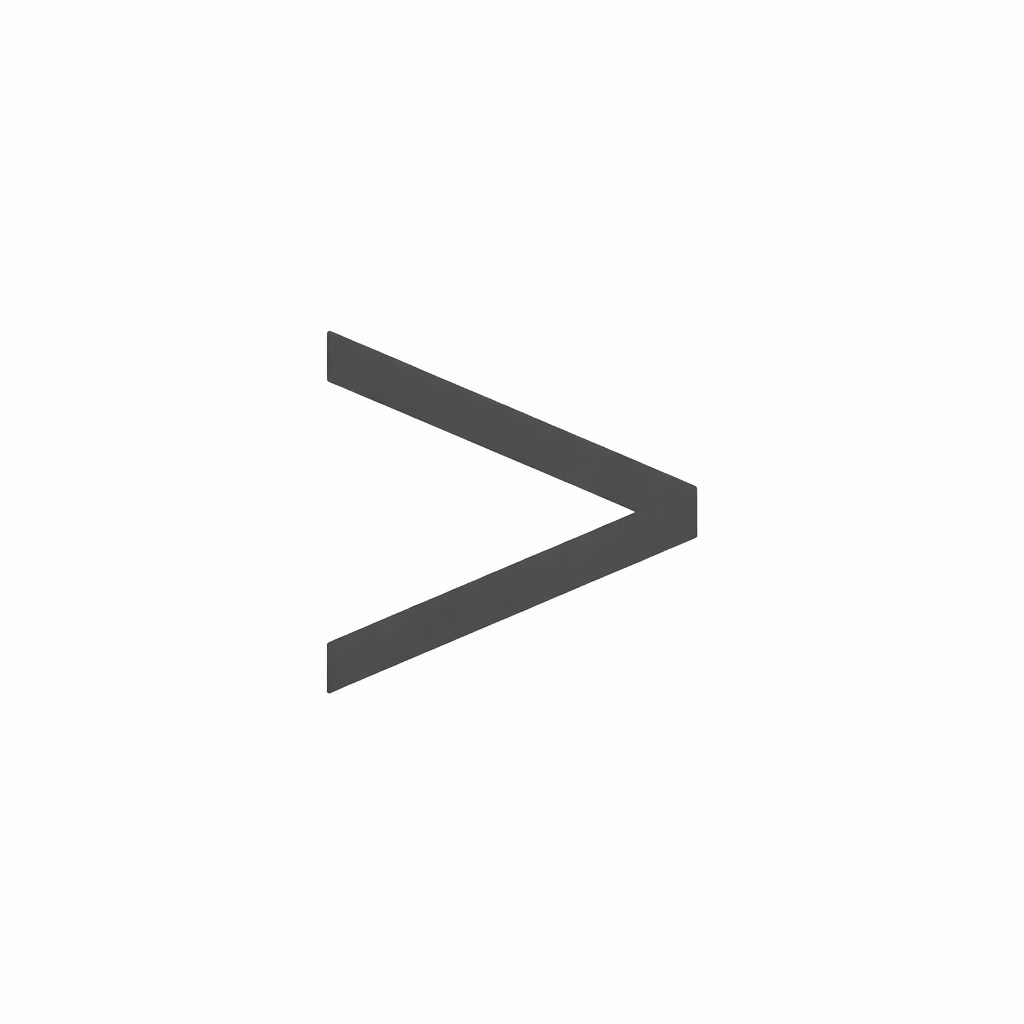
The Opposite Symbol of the More Than Sign
To fully understand the more than sign, it is helpful to know its opposite symbol.
- More than sign:
> - Less than sign:
<
While the more than sign shows that the left value is greater, the less than sign shows that the left value is smaller.
Examples:
- 4 < 9
- 6 > 2
These symbols are often taught together because they are used for comparing numbers.
History of the More Than Sign
The more than sign has an interesting history that dates back to the development of modern mathematics. Mathematical symbols were not always standardized, and early mathematicians often wrote comparisons using words rather than symbols.
The modern comparison symbols > and < were introduced in the 17th century by the English mathematician Thomas Harriot.
Harriot used these symbols in his work Artis Analyticae Praxis, published in 1631. His goal was to simplify mathematical writing and make comparisons easier to read.
Over time, these symbols became widely accepted and are now used in mathematics worldwide.
Understanding the Structure of the More Than Sign
One helpful way to remember how the more than sign works is by looking at its shape.
The symbol > looks like a sideways letter “V”. The open side faces the larger number, and the pointed side faces the smaller number.
Example
12 > 5
In this example:
- 12 is greater
- 5 is smaller
- The open side faces 12
Another example:
25 > 20
The larger number (25) is on the open side of the symbol.
How Children Learn the More Than Sign
Teachers often use creative methods to help children remember comparison symbols.
The Hungry Alligator Method
One popular method is called the hungry alligator rule.
The symbol is imagined as an alligator’s mouth. The alligator always wants to eat the bigger number, so its mouth opens toward the larger value.
Example:
9 > 4
The “alligator mouth” opens toward 9 because it is bigger.
This simple trick helps many young learners remember which direction the symbol should face.
Examples of the More Than Sign in Mathematics
Understanding examples is the best way to learn how to use the symbol correctly.
Simple Number Comparisons
- 10 > 6
- 7 > 3
- 21 > 19
Comparing Larger Numbers
- 105 > 98
- 500 > 250
- 1,000 > 900
Comparing Decimals
The more than sign can also compare decimal numbers.
Examples:
- 5.6 > 5.2
- 3.75 > 3.70
- 9.1 > 8.9
Comparing Fractions
The symbol also works with fractions.
Examples:
- 3/4 > 1/2
- 5/6 > 2/3
Fractions are compared by converting them to decimals or finding common denominators.
The More Than Sign in Algebra
In algebra, the more than sign is often used in inequalities. An inequality shows that two expressions are not equal but instead have a relationship of greater or smaller.
Example:
x > 10
This means the variable x can be any number greater than 10.
Possible values include:
- 11
- 20
- 100
But not:
- 10
- 9
- 5
Another example:
y > 3
This indicates that y must be greater than 3.
Inequalities are widely used in algebra to represent ranges of possible values.
The More Than Sign in Graphs
Inequalities involving the more than sign can be represented visually on number lines and graphs.
For example:
x > 5
On a number line:
- The number 5 is shown with an open circle.
- The shaded line extends to the right, representing numbers greater than 5.
This graphical representation helps students visualize inequalities.
Using the More Than Sign in Programming
The more than sign is not limited to mathematics. It is also a key symbol in many programming languages.
In programming, the symbol > is used as a comparison operator.
Example in programming logic:
if (10 > 5)
This statement checks whether 10 is greater than 5. If the condition is true, the program performs a specific action.
Programming languages that use this operator include:
- Python
- JavaScript
- Java
- C++
Developers rely on comparison operators like the more than sign to control program behavior and decision-making.
More Than Sign in Spreadsheets and Data Analysis
Spreadsheet tools frequently use the more than sign in formulas and logical functions.
For example, in Microsoft Excel:
=IF(A1>50,"Pass","Fail")
This formula checks if the value in cell A1 is greater than 50. If it is, the result will be “Pass”; otherwise, it will show “Fail”.
Similarly, in Google Sheets, the symbol works in the same way.
Data analysts often use it to filter values, compare numbers, and create conditions in formulas.
Everyday Uses of the More Than Sign
Although it originates in mathematics, the more than sign appears in many everyday situations.
Age Requirements
Example:
Age > 18
This means a person must be older than 18 to qualify for something.
Financial Conditions
Example:
Income > $50,000
This indicates a requirement that income must exceed $50,000.
Performance Metrics
Example:
Score > 80%
This could represent a passing or excellent grade.
More Than Sign vs Greater Than or Equal To
Another related symbol is ≥, which means greater than or equal to.
Example:
x ≥ 10
This means x can be:
- 10
- 11
- 20
- 100
But not numbers smaller than 10.
The difference is simple:
- > means strictly greater
- ≥ includes the value itself
Common Mistakes When Using the More Than Sign
Even though the symbol is simple, people sometimes use it incorrectly.
Reversing the Direction
Example of incorrect comparison:
3 > 8
This is wrong because 3 is smaller than 8.
Correct form:
8 > 3
Confusing With Less Than Sign
Students sometimes confuse > and <. Practicing number comparisons helps eliminate this confusion.
Tips for Remembering the More Than Sign
Here are some helpful memory tricks.
1. Hungry Alligator Rule
The open side always eats the bigger number.
2. Bigger Side Faces Bigger Number
The wider opening always points toward the larger value.
3. Think of the Letter “L”
Some teachers suggest remembering:
- L for Less Than
- The less than sign looks like <
This helps distinguish the symbols.
Advanced Mathematical Uses
The more than sign is also used in higher-level mathematics.
Inequality Systems
Example:
x > 5
x < 20
This means x must be between 5 and 20.
Calculus and Limits
Mathematicians use inequalities to describe ranges and limits of functions.
Statistics
In statistics, inequalities help define probability ranges and thresholds.
The More Than Sign in Computer Markup
The symbol also appears in markup languages such as HTML.
Example:
<p>Hello World</p>
Here, the > symbol closes the opening tag.
Web developers work with this symbol frequently when building websites and digital content.
Keyboard Shortcuts for the More Than Sign
Typing the more than sign is very easy.
On Windows
Press:
Shift + .
On Mac
Press:
Shift + .
On Smartphones
The symbol is available in the numbers and symbols section of the keyboard.
Teaching the More Than Sign in Schools
Educators often introduce comparison symbols in early math lessons. Activities used in classrooms include:
- Number comparison games
- Flashcards
- Interactive worksheets
- Number line exercises
These methods help students build a strong understanding of numerical relationships.
Why the More Than Sign Is Important
The more than sign may appear small, but it plays a major role in many areas of knowledge.
1. Mathematical Comparison
It helps compare numbers and quantities quickly.
2. Logical Decision Making
In programming and algorithms, comparisons determine outcomes.
3. Data Analysis
Researchers and analysts rely on inequalities to filter and interpret data.
4. Scientific Calculations
Scientists use comparison symbols when defining thresholds, ranges, and measurements.
Without comparison symbols, expressing relationships between numbers would be much more difficult.
Real-Life Examples
Here are a few practical scenarios.
Shopping
Price > Budget means the item is too expensive.
Health
Heart Rate > 100 bpm might indicate an abnormal condition.
Education
Marks > 90% may represent an A grade.
These simple comparisons make decision-making easier in everyday life.
Final Thoughts
The more than sign ( > ) is one of the most fundamental symbols used in mathematics and computing. Although it is simple in appearance, its role is incredibly powerful. It helps compare values, create mathematical inequalities, guide computer programs, and analyze data.
From elementary school math lessons to advanced scientific research, this symbol remains essential for understanding relationships between numbers and quantities. Learning how to use it correctly allows students, professionals, and researchers to communicate numerical information clearly and efficiently.
By mastering the rules, examples, and applications discussed in this guide, anyone can confidently understand and use the more than sign in mathematics, technology, and everyday life.
READ MORE : GROW MAGAZINES
